Language


 WhatsApp

Henan Enda New Material Co., Ltd


Industrial melamine foam for automotive and rail insulation can be sourced directly from manufacturers that supply the material for acoustic, thermal, and fire-protection applications. Henan Enda New Material Co., Ltd. manufactures industrial melamine foam and lists automotive and rail transit among its transportation applications, including high-speed rail, light rail, and subway projects.
For these applications, the specification is usually more important than simply finding the highest-density foam. Density, thickness, weight, thermal conductivity, acoustic performance, fire rating, temperature resistance, and processing options all need to match the actual installation.
A suitable industrial melamine foam supplier should have more than a standard foam product on its catalog. Transportation projects may require different densities and thicknesses for walls, ceilings, equipment areas, ducts, floors, or engine-related components.
Henan Enda's industrial melamine foam range covers sound absorption, heat and thermal insulation, and fire protection. Its automotive application information lists melamine foam for high-speed rail, light rail, subway, and other vehicle applications, with potential uses including equipment bays, ducts, doors, interior walls, roofs, seats, flooring, and engine surrounds.
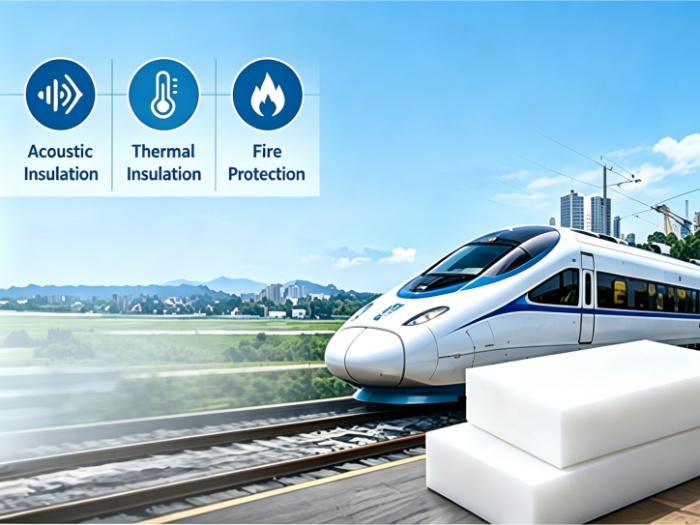 Automotive insulation melamine foam
That application information gives buyers a more useful starting point than simply searching for a generic “melamine foam supplier.” The material can then be specified around the actual component and operating environment.
Automotive and rail insulation can involve several requirements at once. A material may need to absorb noise while also limiting heat transfer, remaining lightweight, and providing suitable flame-retardant performance.
Enda publishes the following specifications for its industrial melamine foam:
| Property | Reported specification |
| Thermal conductivity | 0.034 W/(m·K) |
| Noise Reduction Coefficient (NRC) | 0.95 |
| Working temperature | -200°C to 240°C |
| Open-cell structure | 99% |
| Fire performance | DIN4102 B1 / UL94-V0 |
The 0.034 W/(m·K) thermal conductivity is relevant to thermal insulation, while the NRC 0.95 rating is relevant to acoustic applications. The reported temperature range can also be important where insulation is exposed to substantial temperature variation.
Fire classification should be considered according to the requirements of the specific vehicle or rail project. DIN4102-B1 and UL94-V0 are individual test classifications and should not be treated as automatic compliance with every automotive or railway standard.
Not always.
Although “high-density industrial melamine foam” is a common sourcing phrase, density alone does not determine whether the material is suitable. Transportation projects may place a strong emphasis on weight, so the required density needs to be considered together with thickness, acoustic performance, thermal requirements, and installation space.
Enda's automotive melamine foam information lists a density range of 8–64 kg/m³. The same product information covers applications in high-speed rail, light rail, subway, and vehicles.
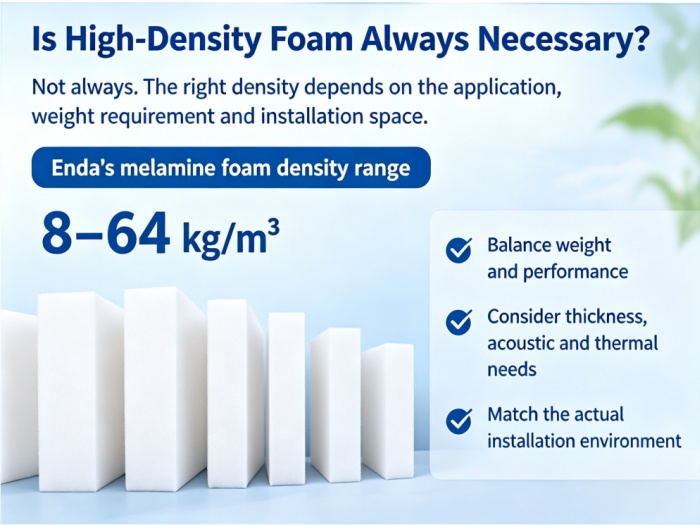 How to choose the right melamine foam
This means a buyer does not necessarily need the highest-density material available. A lighter grade may be more appropriate when weight reduction is an important part of the project, while other applications may call for a different density or thickness.
Standard sheets do not always fit transportation components without additional cutting or processing.
Henan Enda provides customized sizes for its industrial melamine foam products. Its product range also includes processed forms such as melamine foam pipe insulation, while its acoustic foam products can be customized in thickness, panel size, shape, color, and cutting pattern.
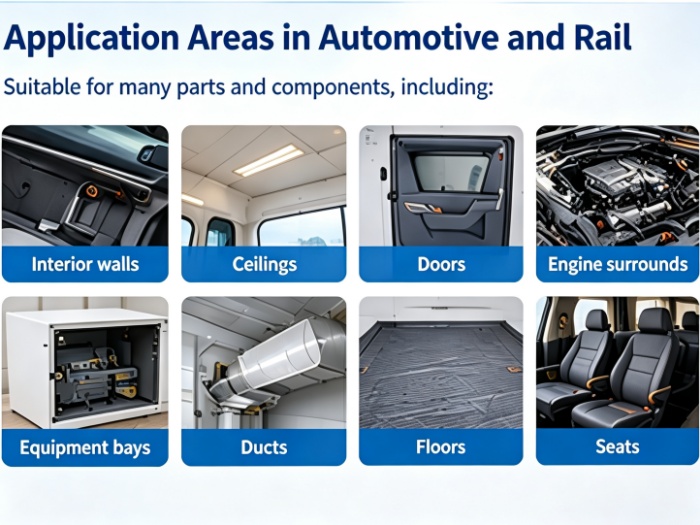 Melamine foam used in automotive areas
This is relevant when insulation needs to fit a particular wall panel, duct, pipe, equipment bay, ceiling, or other limited installation space. Buyers can specify the required dimensions and application before production instead of treating a standard sheet as the only available option.
Henan Enda New Material Co., Ltd. was established in 2011 and has 15 years of manufacturing experience as of 2026. The company supplies customers in 90+ countries and has product lines covering both cleaning sponge and industrial foam applications.
For industrial melamine foam, Enda states that it has its own melamine foam production line and supplies materials for acoustic absorption, thermal insulation, and fire protection. Transportation is also included in its listed application areas.
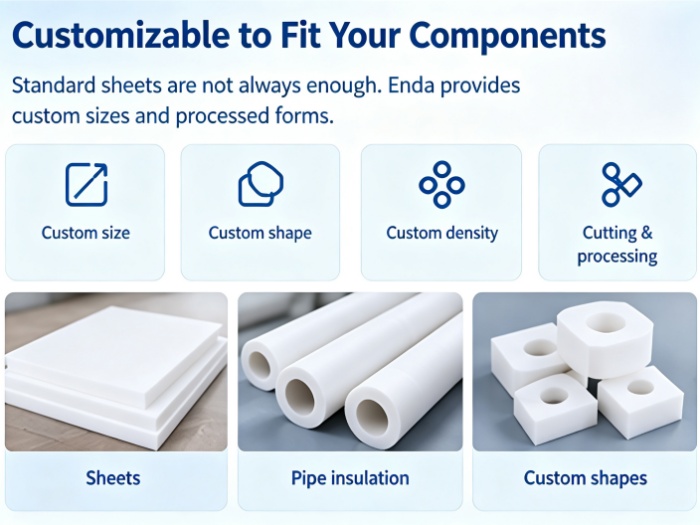 Henan Enda Company supplies customizable melamine foam for industrial uses
Its automotive and transportation product information provides a 8–64 kg/m³ density range, while published industrial foam specifications include 0.034 W/(m·K) thermal conductivity, NRC 0.95, a -200°C to 240°C working temperature range, and DIN4102 B1 / UL94-V0 fire-retardant grades.
For an automotive or rail insulation project, buyers can discuss the required density, thickness, dimensions, operating conditions, and processing requirements with Enda before requesting a quotation or sample.
Sourcing industrial melamine foam for automotive or rail insulation is mainly about finding a supplier whose material and processing capabilities fit the project. Density is only one part of the specification; acoustic performance, thermal conductivity, fire performance, weight, thickness, and application-specific dimensions can all affect the final choice.
Henan Enda supplies industrial melamine foam for automotive and rail transit applications, including high-speed rail, light rail, and subway projects, with published technical data and customized processing options.
What density of melamine foam is used for automotive insulation?
There is no single density for every application. Enda's automotive melamine foam is listed at 7–24 kg/m³, allowing density to be matched with weight, thickness, acoustic, and thermal requirements.
Can melamine foam be supplied in custom thicknesses for rail vehicles?
Yes. Industrial melamine foam can be supplied in customized dimensions and processed forms. The required thickness and size should be specified according to the available installation space.
What fire ratings are available for industrial melamine foam?
Enda's published industrial foam specifications include DIN4102 B1 and UL94-V0. Project-specific railway or automotive requirements should be confirmed separately.
Can melamine foam provide both thermal and acoustic insulation?
Yes. Enda's industrial melamine foam has a reported thermal conductivity of 0.034 W/(m·K) and NRC 0.95, supporting both thermal and acoustic insulation applications.
(Your information is only used to communicate between us and will not reveal your privacy)